Lift Station Rehabilitation with Protective Coatings

A manhole sits in a sewer line doing essentially nothing mechanical, just providing access while gravity does the actual work of moving wastewater downhill. A lift station is a completely different animal. It houses pumps, controls, valves, and a wet well that fills and empties on a cycle dozens of times a day, actively working against gravity to push wastewater somewhere it can’t reach on its own. That constant mechanical activity, combined with a wet well environment that concentrates sewer gas even more aggressively than a typical manhole, is exactly why lift station coating rehabilitation is its own specialized problem rather than a bigger version of manhole rehab.
This guide covers what makes lift stations corrode differently and often faster than the rest of a collection system, what a proper rehabilitation project actually involves, and why bypass pumping is the logistical challenge that shapes almost every other decision on a lift station job, from coating selection to how long the whole project realistically takes.
Why Lift Stations Corrode Harder Than a Typical Manhole
The wet well, the chamber where incoming wastewater collects before the pumps lift it out, creates conditions that concentrate hydrogen sulfide gas generation more intensely than a straight run of gravity sewer pipe typically does. Wastewater sits in the wet well for a period before being pumped out, giving anaerobic bacteria time to generate hydrogen sulfide, and the pumping action itself, agitating and aerating the wastewater as it’s lifted, releases more of that dissolved gas into the wet well’s headspace than calm, steady flow would.
That gas then does exactly what it does in any concrete or coated steel structure: aerobic bacteria on exposed surfaces above the waterline convert it to sulfuric acid, attacking concrete and corroding steel components directly. In a lift station, this process has more surface area and more mechanical hardware to attack than a simple manhole chamber does, valve vaults, pump mounting hardware, discharge piping, and structural walls all exposed to the same aggressive atmosphere.
The Mechanical Complication Manholes Don’t Have
Beyond the corrosion chemistry, lift stations introduce a mechanical dimension that changes how rehabilitation projects need to be planned. Pumps vibrate. Water levels fluctuate constantly as the wet well fills and empties on its operating cycle. Structural components experience cyclical stress that a static manhole simply doesn’t. A coating or lining system chosen for a lift station needs to handle that combination of chemical attack and mechanical stress simultaneously, not just one or the other, which narrows the field of genuinely suitable materials compared to a straightforward manhole application.
Fluctuating water levels also mean the coating needs to perform well both submerged and in the exposed headspace above the waterline, since the exact boundary between wet and dry shifts constantly as the station cycles through its normal operation. A coating that performs beautifully in one condition but poorly in the other isn’t a real solution for a lift station wet well.
Why Bypass Pumping Shapes Everything Else
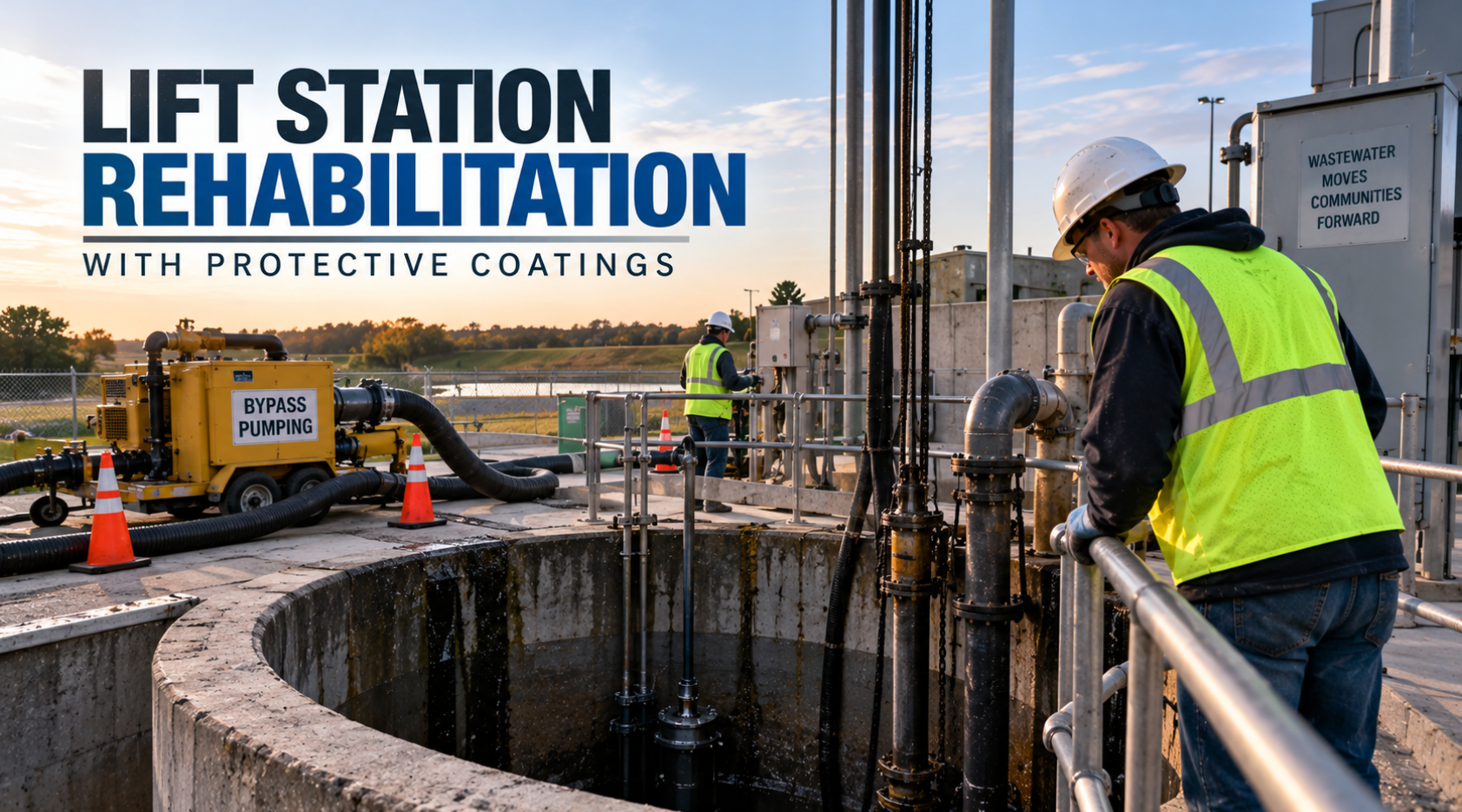
This is the logistical reality that separates lift station coating rehabilitation from nearly every other wastewater coating project. A lift station can’t simply be shut off the way a manhole can be isolated for repair work, since wastewater keeps arriving whether or not the station is available to pump it out. Rehabilitating the wet well means temporarily diverting incoming flow, typically through temporary bypass pumping equipment that lifts wastewater around the station while the permanent structure is drained, cleaned, repaired, and coated.
Bypass pumping is expensive, and every day it runs adds to the project’s total cost, which creates real pressure to move through assessment, prep, and coating as efficiently as possible without cutting corners that would just force a repeat project sooner than expected. This is exactly why coating systems with fast cure times carry outsized practical value in lift station rehabilitation specifically, since a shorter cure window directly translates to fewer days of bypass pumping and a faster return to normal operation.
What Lift Station Coating Rehabilitation Actually Involves
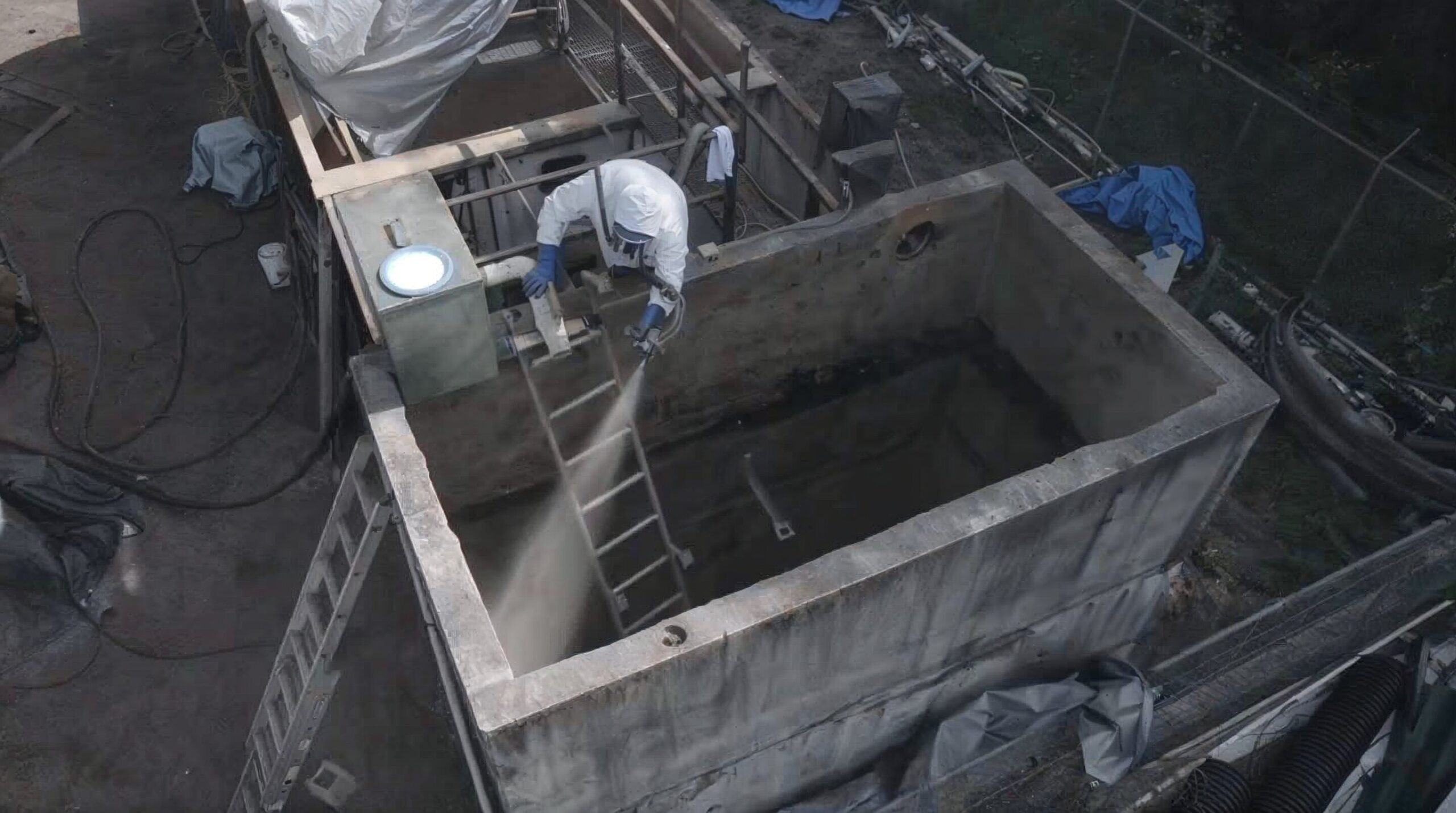
The process starts with taking the station offline through bypass pumping, followed by draining and a thorough inspection of the wet well, valve vault, and any accessible piping. Given the mechanical and corrosion combination covered above, this inspection needs to check both structural condition, concrete cracking, steel section loss, and equipment mounting integrity, and pure corrosion damage from the sulfuric acid cycle.
Structural repairs, addressing any cracking, spalling, or corroded mounting hardware, happen before coating begins, since a new lining applied over unrepaired structural issues just delays the same problem. Surface preparation follows, profiling and cleaning the substrate to give the new coating system a proper bond, an especially critical step given how much surface area and how many different substrate types, concrete walls, steel components, existing hardware, a lift station typically presents compared to a simple manhole chamber.
The coating itself is applied to the specified thickness, with particular attention to detail work around pump mounts, pipe penetrations, and any equipment that has to remain functional once the wet well returns to service. Cure time matters enormously here given the bypass pumping cost pressure covered above, and the station only returns to normal operation once the coating has fully cured according to its documented timeline, not before.
Certification Considerations for Lift Stations
Unlike a drinking water tank, a lift station wet well isn’t handling potable water, so NSF/ANSI 61 certification generally isn’t the relevant standard here the way it would be for a cistern or reservoir project. That said, coating selection still needs to account for the specific chemical exposure a lift station presents, sustained hydrogen sulfide and sulfuric acid attack, along with whatever industrial or commercial waste streams feed into the specific system, since not every wastewater collection system carries the same chemical profile. Confirming a coating’s documented resistance to the actual conditions a specific lift station experiences matters more than relying on a generic “wastewater-rated” label.
Lift Station vs. Manhole Rehabilitation Comparison
| Factor | Lift Station | Manhole |
|---|---|---|
| Mechanical stress | Yes, pump vibration, fluctuating water levels | Minimal, largely static structure |
| Corrosion concentration | Higher, gas release intensified by pumping action | Present, but typically less concentrated |
| Downtime management | Requires bypass pumping, cost-sensitive | Can often be isolated more simply |
| Coating requirements | Must handle chemical and mechanical stress together | Primarily chemical resistance focused |
| Access complexity | Pumps, controls, and hardware complicate access | Generally simpler chamber access |
Things to Consider Before a Lift Station Rehabilitation Project
- Has the assessment covered both structural and mechanical condition, not just visible corrosion on exposed surfaces?
- Is the bypass pumping plan realistic for the project’s expected duration, including contingency for findings that extend the timeline once the station is drained?
- Does the selected coating system have documented performance under both submerged and headspace conditions, given how much the waterline shifts during normal operation?
- Has the coating’s chemical resistance been confirmed against this specific system’s actual waste stream, rather than a generic wastewater rating?
- Is detail work around pump mounts and penetrations getting the same attention as the flat wall surfaces, since these transition points are common failure locations?
Maintenance After Rehabilitation
A properly rehabilitated lift station still benefits from periodic inspection, particularly given how much mechanical activity continues after the coating work is complete. Checking for early coating wear near pump mounts and at the waterline transition zone, monitoring for any signs of renewed corrosion, and keeping documentation of the original rehabilitation specification on file all support long-term performance and give future maintenance decisions a real baseline to work from rather than starting from scratch each time a question comes up.
Frequently Asked Questions
Why do lift stations need different coating consideration than manholes?
Lift stations combine aggressive hydrogen sulfide corrosion with mechanical stress from pump vibration and fluctuating water levels, a combination manholes generally don’t experience to the same degree, which narrows the field of coating systems genuinely suited to the application.
How long does bypass pumping typically run during a lift station rehab project?
It varies by project scope and what the assessment finds once the station is drained, which is exactly why efficient scheduling and fast-curing coating systems carry real value in reducing the total bypass pumping duration and cost.
Do lift stations need NSF/ANSI 61 certified coatings?
Generally not, since lift station wet wells handle wastewater rather than potable water, so that specific certification isn’t the relevant standard here, though chemical resistance for the actual waste stream still needs to be confirmed.
Can a lift station be rehabilitated without shutting off incoming flow entirely?
The wet well itself needs to be drained and dry for proper rehabilitation, but incoming wastewater flow continues to be managed through temporary bypass pumping rather than being stopped altogether.
What’s the most common reason a lift station coating fails prematurely?
Inadequate attention to detail work around pump mounts, penetrations, and the fluctuating waterline zone tends to cause more premature failures than problems with the flat wall coating itself.
Conclusion
Lift station coating rehabilitation asks more of a coating system, and of the project planning around it, than a standard manhole rehab does, thanks to the combination of concentrated corrosion and genuine mechanical stress these structures experience daily. Getting the assessment thorough enough to catch both problems, choosing a coating proven under both submerged and headspace conditions, and managing bypass pumping efficiently are what separate a lift station rehabilitation that holds up for years from one that’s back on the repair schedule sooner than the budget ever accounted for, pulling crews and equipment away from other priorities all over again.
Start your own wastewater coatings business
Get equipment, training and lifetime support with the ArmorThane system — no franchise fees.